Impact
✅ Accelerated Time to Clarity: 30 days → 3-5 days for customers to understand value
✅ Research-Driven: 11 user research sessions across 2 rounds informed every decision
✅ Leadership at Scale: Owned end-to-end product from POC through alpha, managing cross-functional teams across Cisco and Duo
The Post Acquisition Gap
You know that feeling when you acquire something and it just... sits there? That’s exactly what happened with Cisco Identity Intelligence (CII) after Cisco acquired Oort. Thousands of Duo customers suddenly had access to this powerful identity analytics platform, but they weren't utilizing it.
As the Lead Product Designer on the integration, I walked into a classic post-acquisition gap. The platforms had no integration, no awareness, and no natural path for someone to go from 'I have access' to 'I understand why this matters to me.' Customers were entitled to the product, but the bridge hadn't been built yet.
The Post Acquisition Gap
You know that feeling when you acquire something and it just... sits there? That’s exactly what happened with Cisco Identity Intelligence (CII) after Cisco acquired Oort. Thousands of Duo customers suddenly had access to this powerful identity analytics platform, but they weren't utilizing it.
As the Lead Product Designer on the integration, I walked into a classic post-acquisition gap. The platforms had no integration, no awareness, and no natural path for someone to go from 'I have access' to 'I understand why this matters to me.' Customers were entitled to the product, but the bridge hadn't been built yet.
Diagnosing the 30-Day Confusion Gap
To design an effective solution, we first had to understand the baseline experience. Audits and stakeholder interviews showed that customers were taking an average of 30 days to reach 'clarity' the point where they finally understood the CII platform’s value. This delay drove customer churn, they felt they lacked the time or internal resources to properly commit to the product.
Impact
✅ Accelerated Time to Clarity: 30 days → 3 days for customers to understand value
✅ Research-Driven: 11 user research sessions across 2 rounds informed every decision
✅ Leadership at Scale: Owned end-to-end product from POC through alpha, managing cross-functional teams across Cisco and Duo
The Post Acquisition Gap
You know that feeling when you acquire something and it just... sits there? That’s exactly what happened with Cisco Identity Intelligence (CII) after Cisco acquired Oort. Thousands of Duo customers suddenly had access to this powerful identity analytics platform, but they weren't utilizing it.
As the Lead Product Designer on the integration, I walked into a classic post-acquisition gap. The platforms had no integration, no awareness, and no natural path for someone to go from 'I have access' to 'I understand why this matters to me.' Customers were entitled to the product, but the bridge hadn't been built yet.
Defining Our Strategic North Star
To guide the integration, I established a framework based on user psychology. We needed to move from 'exploring data' to 'taking action.' I defined three core UX principles to guide our design decisions.
First, we had to 'meet people where they are.' Not everyone is a security expert; some customers are just starting with MFA, while others are far more advanced. The experience needed to match their technical comfort.
Second, we had to 'show value immediately.' Instead of focusing on risks and problems, we led with one high-impact action users could take right away. Quick wins build the confidence needed to establish long-term trust.
Finally, we had to 'Design for the moment, not the dashboard.' This wasn't about building CII inside Duo. This was about designing for the moment someone goes from 'I have access' to 'Oh, I see why this matters.'
The pivot: when research shows you’re wrong
The pivot: when research shows you’re wrong
The pivot: when research shows you’re wrong
I remember the debrief. Engineering was ready, and the team wanted to move forward to hit our quarterly goal.
But I kept thinking: if customers are asking to customize everything, we haven't made it clear what this actually is. I brought it to the team differently.
Instead of asking 'How do we add more features?' I asked: 'HMW make this introduction digestible and clear?' We needed to pivot.
I remember the debrief. Engineering was ready, and the team wanted to move forward to hit our quarterly goal.
But I kept thinking: if customers are asking to customize everything, we haven’t made it clear what this actually is. I brought it to the team differently.
Instead of asking ‘How do we add more features?’ I asked: ‘HMW make this introduction digestible and clear?’ We needed to pivot.
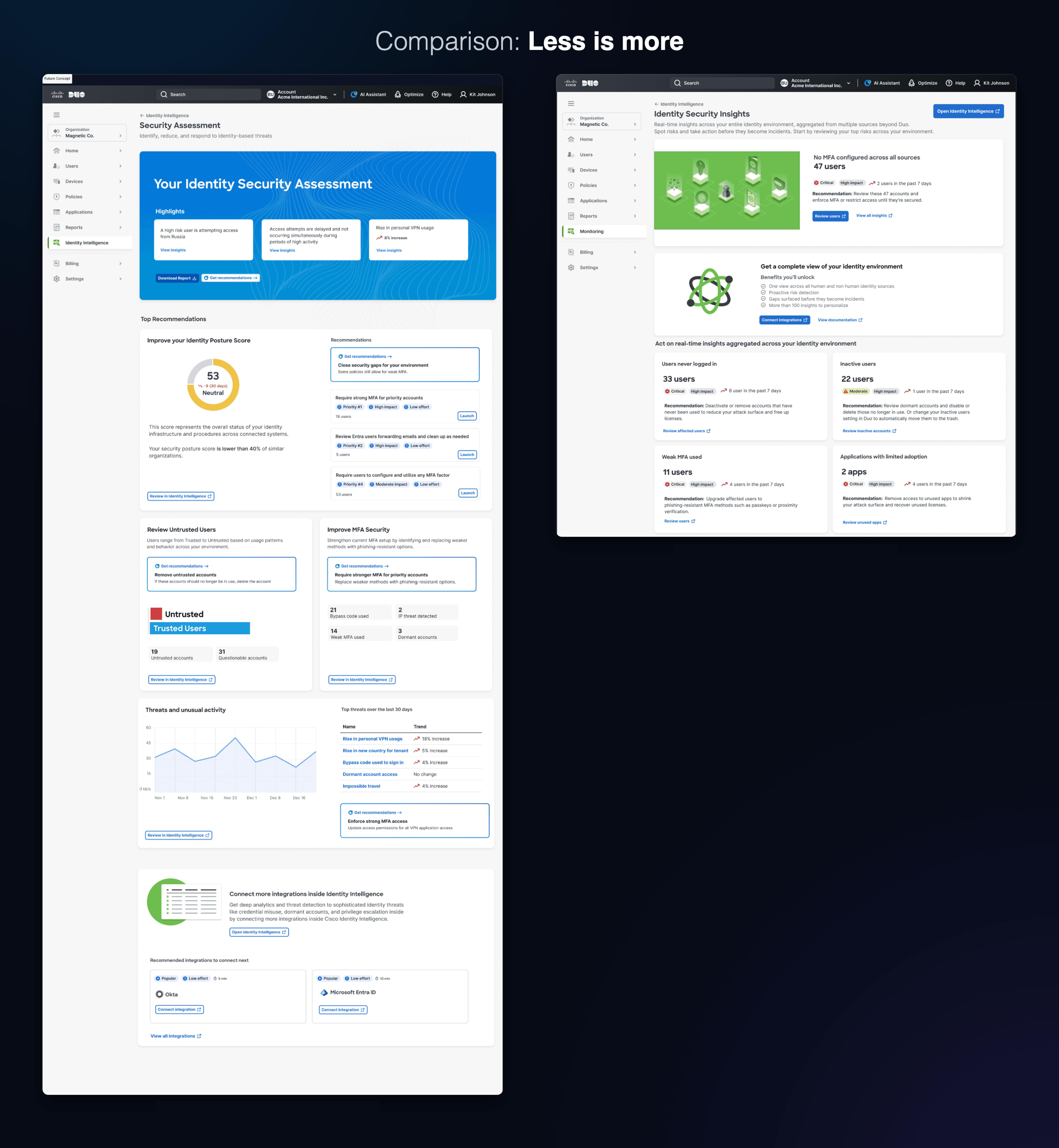
We initially designed a comprehensive ‘Security Assessment’ page, complete with a numerical Identity Posture Score (e.g., 53, Neutral), top recommendations, and higher-level org health views. It was a data-heavy dashboard ready to ship. But when I conducted Round 1 research with six users, the flaws in our assumptions became glaringly obvious.
Users started asking for the ability to create and manage checks, customize user page alerts, and adjust viewer role controls. Most of what they wanted already existed in the full CII platform. They weren’t saying the design was incomplete; they were trying to turn it into a full dashboard because they lacked the context of what this feature was actually supposed to be.
I remember the debrief. Engineering was ready, and the team wanted to move forward to hit our quarterly goal.
But I kept thinking: if customers are asking to customize everything, we haven’t made it clear what this actually is. I brought it to the team differently.
Instead of asking ‘How do we add more features?’ I asked: ‘HMW make this introduction digestible and clear?’ We needed to pivot.
The First Concept: Comprehensive Security Assessment
The First Concept: Comprehensive Security Assessment
The First Concept: Comprehensive Security Assessment
Shipping Fast by Bringing the Team Along
From 30 Days to Clarity: Redesigning the CII Introduction
From 30 Days to Clarity: Redesigning the CII Introduction
We could have tried to replicate the full Identity Assessment. Instead, we got specific: five curated metrics that would help customers move from confusion to understanding
15 customers signed up as soon as we shipped the alpha, but the biggest impact was on the onboarding timeline. By prioritizing a curated experience over a complex dashboard, we cut the 'Time to Clarity' from 30 days to just 3-5 days.
15 customers signed up as soon as we shipped the alpha, but the biggest impact was on the onboarding timeline. By prioritizing a curated experience over a complex dashboard, we cut the 'Time to Clarity' from 30 days to just 3-5 days.
Validating the Pivot Through Action
Validating the Pivot Through Action
Validating the Pivot Through Action
Product management agreed the evidence wasn't there yet to ship the dashboard, so we entered Round 2 of research with a drastically simplified approach.
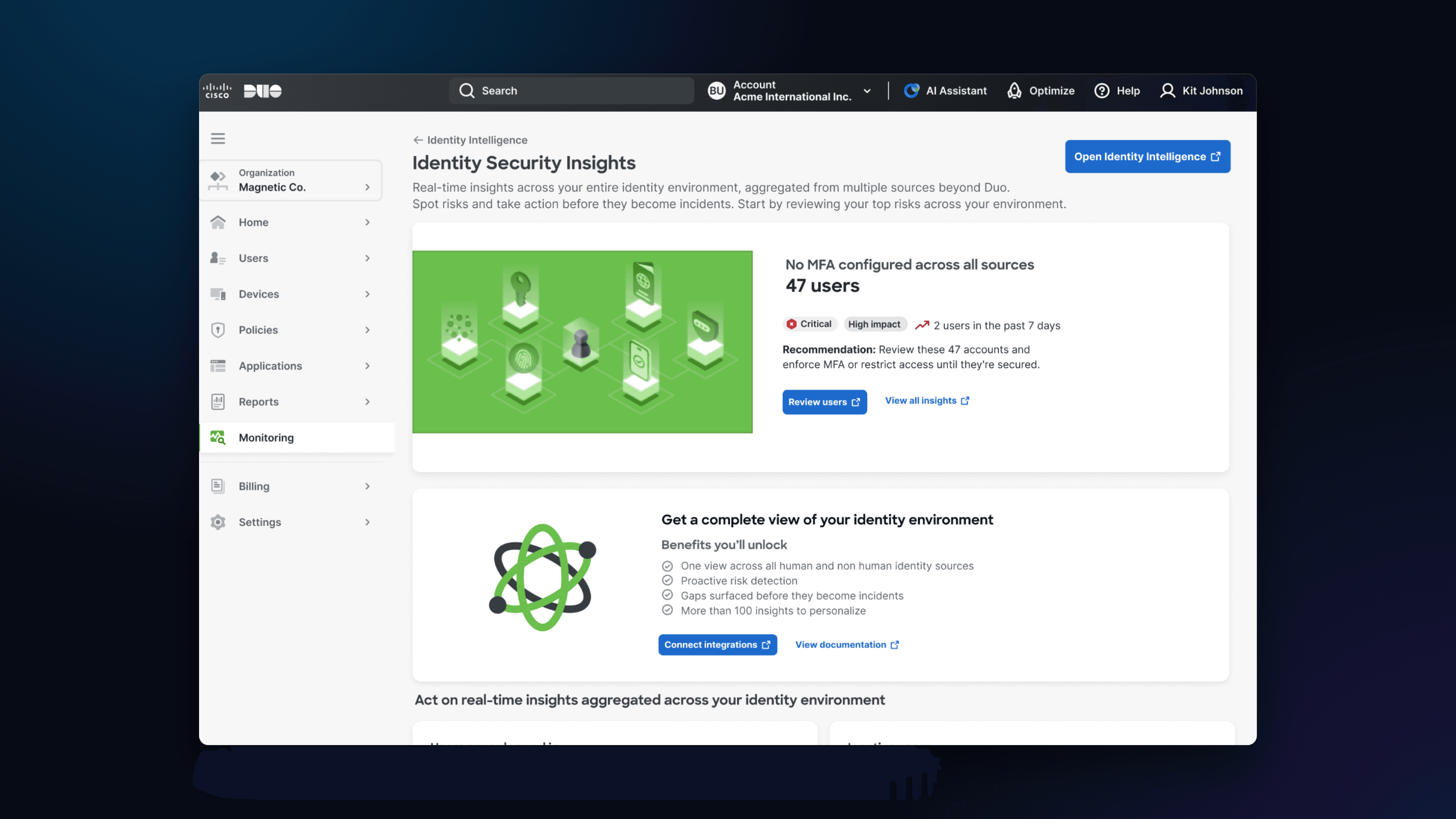
We pivoted from a 'comprehensive Security Assessment' to 'Identity Security Insights' a smaller, focused design acting as an actual introduction rather than a command center.
I went back and looked at what we could actually leverage, pulling a list of updated open APIs from the VP of Engineering and cross-referencing it against actual usage data from existing CII customers. Three of the five Round 2 participants immediately flagged 'Non-MFA users' as their highest-priority risk. That wasn't a guess; that was signal. We decided to focus on this single 'aha moment' instead of three headline items.
Shipping Fast by Bringing the Team Along
Shipping Fast by Bringing the Team Along
Shipping Fast by Bringing the Team Along
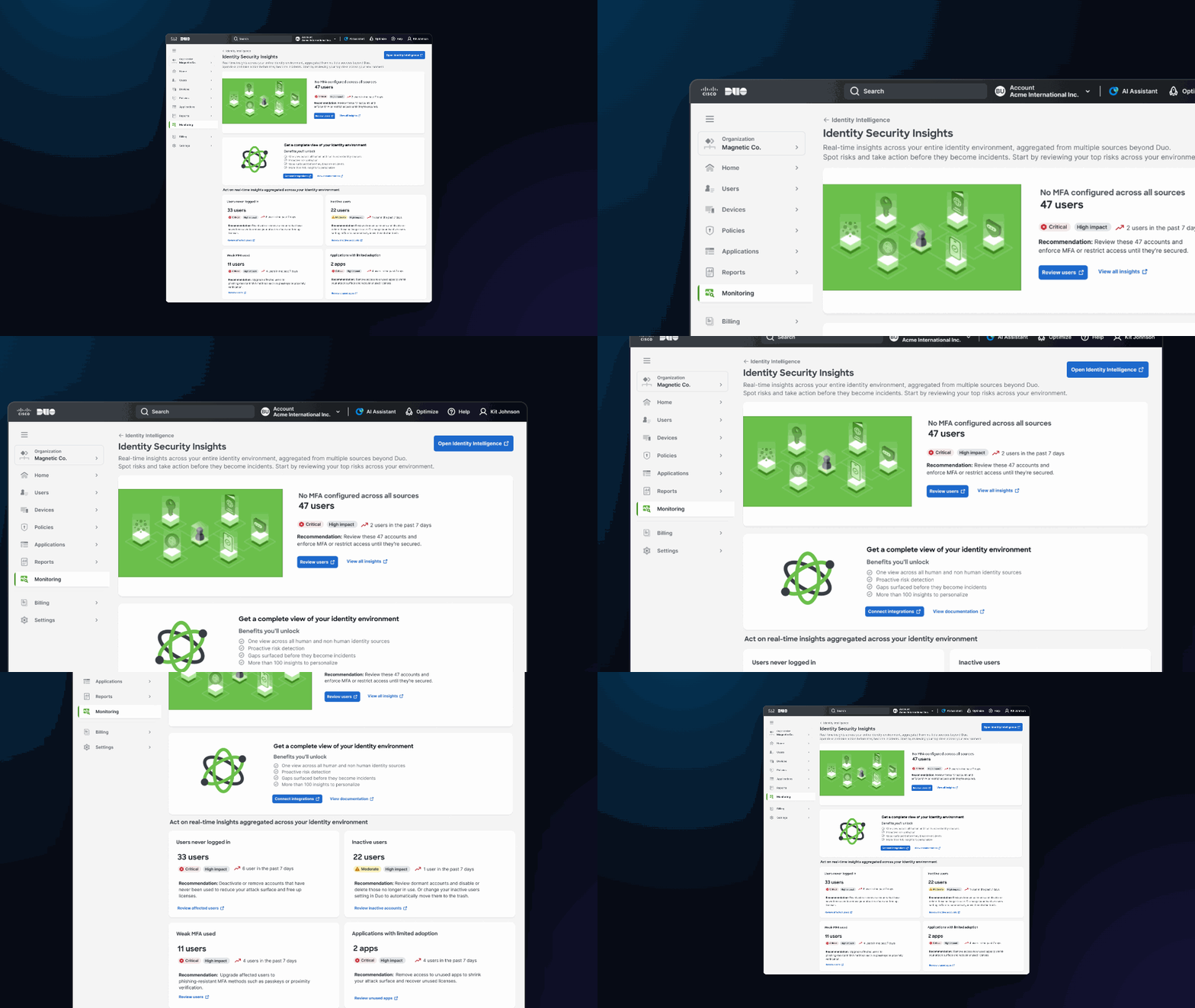
Because the whole team, Product, Engineering, and Design, had been present during the user research sessions, we were all hearing the same customer feedback firsthand. There was no need for lengthy handoff documents or debates about feature priority. Everyone understood exactly what we were building and, more importantly, why.
Beyond just my direct team, I wanted to ensure this data-driven culture permeated the broader organization. I built a custom Amplitude dashboard designed to track our CII adoption metrics and map them against the broader identity design team's OKRs. The vision was bigger than one project; it was about creating a home base for the team to start all design work grounded in real data
Because the whole team, Product, Engineering, and Design, had been present during the user research sessions, we were all hearing the same customer feedback firsthand. There was no need for lengthy handoff documents or debates about feature priority. Everyone understood exactly what we were building and, more importantly, why.
Beyond just my direct team, I wanted to ensure this data-driven culture permeated the broader organization. I built a custom Amplitude dashboard designed to track our CII adoption metrics and map them against the broader identity design team's OKRs. The vision was bigger than one project; it was about creating a home base for the team to start all design work grounded in real data
Measuring what actually moves
Measuring what actually moves
Measuring what actually moves
Shipping isn't the goal; adoption is. To measure the impact of our pivot, I built a tracking system before launch. We monitored three specific funnels to see if 'Identity Security Insights' was driving the intended behaviors.
Funnel 1 tracked Cross-Product Conversion, following users from Duo Admin Panel impressions to CII login rates with a target click-through rate of 20%.
Funnel 2 measured 'Check-to-Action': how many customers viewed the Non-MFA metric, acted on it, and changed their policy within 7 days.
Shipping isn't the goal; adoption is. To measure the impact of our pivot, I built a tracking system before launch. We monitored three specific funnels to see if 'Identity Security Insights' was driving the intended behaviors.
Funnel 1 tracked Cross-Product Conversion, following users from Duo Admin Panel impressions to CII login rates with a target click-through rate of 20%.
Funnel 2 measured 'Check-to-Action': how many customers viewed the Non-MFA metric, acted on it, and changed their policy within 7 days.
Shipping isn't the goal; adoption is. To measure the impact of our pivot, I built a tracking system before launch. We monitored three specific funnels to see if 'Identity Security Insights' was driving the intended behaviors.
Funnel 1 tracked Cross-Product Conversion, following users from Duo Admin Panel impressions to CII login rates with a target click-through rate of 20%.
Funnel 2 measured 'Check-to-Action': how many customers viewed the Non-MFA metric, acted on it, and changed their policy within 7 days.
Shipping isn't the goal; adoption is. To measure the impact of our pivot, I built a tracking system before launch. We monitored three specific funnels to see if 'Identity Security Insights' was driving the intended behaviors.
Funnel 1 tracked Cross-Product Conversion, following users from Duo Admin Panel impressions to CII login rates with a target click-through rate of 20%.
Funnel 2 measured 'Check-to-Action': how many customers viewed the Non-MFA metric, acted on it, and changed their policy within
7 days.
The Lesson of the first frame
The Lesson of the first frame
The Lesson of the first frame
Looking back, the biggest lesson was the need for alignment on the first frame. It’s natural to want to show everything when you're excited about what a product can do, but we initially struggled with too many conflicting opinions because we hadn't defined our core objective.
If I were doing this again, I’d prioritize getting leadership to agree on a single goal: that this is an introduction rather than a dashboard. Instead of debating features or what to include, we needed to be clear on the specific purpose of this step in the user journey.